

Mary Liddell
scroll to see the artwork
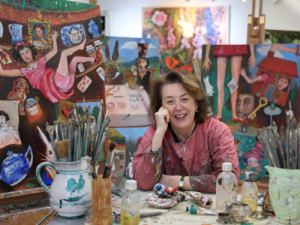
Step inside the vibrant studio of Mary Liddell, where figurative oil paintings and traditional etchings come to life with color, light, and a touch of magic. In this intimate chat, Mary opens up about her Alice in Wonderland-inspired series, a whimsical nod to her family legacy, and shares the secrets behind her ever-evolving painting practice.
Interviewed by Alejandra Christie
There’s a quiet intensity to Mary Liddell’s practice, one that reveals itself not through a bold declaration but through a peaceful rhythm. Sitting in her studio, surrounded by artworks in different stages of finished, it’s clear that painting is not just something she does, but something she lives with, daily and instinctively.
Her art moves between figuration, abstraction and a good touch of surrealism, grounded in observation and led by feeling, with a fluidity that avoids an easy definition. What we see is an artist deeply engaged with the art of looking, of taking time, and in love with the act of creation. We met Mary at her studio in Somerset’s beautiful countryside, where she spoke with sincerity and wit about discipline, doubt, and the evolving landscape of contemporary art.
AC: Mary, the first thing I’d like to ask you is how you would describe your artwork to someone seeing it for the first time?
ML: I do find that question quite difficult. I asked three friends of mine, people who’ve known me since I was very young, and they came up with a few words. One said “fluid”, which I thought was quite funny. Another said “colourful”, and someone else said “uplifting”, which I thought was very flattering. I suppose I would say it’s figurative, although some of it has more abstract or surrealist elements. And like most artists, it’s changed over many years.
AC: You’ve been an artist for a long time. How closely is it tied to who you are?
ML: Completely. I always think I paint, therefore I am. It sounds funny, but it’s true. I’m always looking at things, light, shapes, forms. I’m always thinking about painting. My family will tell you that wherever I go, I end up carrying materials with me. I can’t really live without it.
AC: There’s a real sense of momentum in your work right now. How does painting sit in your life at this stage?
ML: I’m still so excited by it. I want to paint all the time. I do feel quite aware of time now, that I need to use the next ten or twenty years properly. When I was younger, I spent my time balancing other things, raising a family and so on, which is part of life. But now I can focus more. I get up at six in the morning and go into the studio while my mind is fresh. It’s the best time to concentrate.
AC: Do you wait for inspiration, or do you work regardless?
ML: I work regardless. It’s like practising anything, you have to do it every day. You can feel really uninspired and discouraged, but you still have to keep painting. The inspiration comes from doing the work. It’s not there before you start. Although sometimes, if you see something interesting, you do feel immediately inspired. But in the day-to-day, you just have to keep going and get into the flow.
AC: What does that daily rhythm in the studio look like for you?
ML: Early mornings are important. That’s when I can focus properly. I prefer silence when I’m painting, especially when I’m working things out or concentrating. I can’t have distractions or music then. I need to be completely focused.
AC: You work with oil, but also with etching. How does that process differ for you?
ML: It’s quite different. Etching is more structured, there are stages to it, and you have to be quite precise, especially when you’re inking up plates and preparing everything. Talking of music, I actually don’t mind having music on when I’m etching. But painting is much more about concentration and silence in the moment.
AC: What’s something you’ve had to unlearn as an artist?
ML: Quite a lot of what I was taught at art school, actually. At the time, in the early 1980s, there were very strong ideas about what you shouldn’t do. Narrative painting was discouraged, and anything that looked like illustration was not approved of. They were also very against using photographs. I don’t really agree with that now. All paintings have some sort of story, and photographs are just a tool. I use them as reference, not to copy, but I don’t see how you could work without them now.
AC: You’re currently working on a series inspired by Alice in Wonderland. There’s a personal connection there, right?
ML: Yes, my great-great-aunt was Alice Liddell, the original Alice for whom Lewis Caroll wrote the stories. As a student at Christchurch College Oxford, he used to see the Liddell children playing in the gardens below his window, befriended the family and thus the story was born. But I also remember the book very vividly from childhood. I actually found parts of it quite unsettling, especially the original illustrations by Tenniel. There’s something odd about it all – the way things shift, and the scale changing all the time.
AC: What keeps you returning to it as a subject?
ML: I think it’s that sense of things constantly changing. Nothing stays the same, everything is growing or shrinking or shifting. That’s very interesting to work with in painting. It gives you freedom.
AC: With a shift in questioning, I’m interested to ask your thoughts on how the art world has changed, particularly with social media?
ML: It’s much more accessible now, which is a good thing, but it’s also changed how people see art. Anyone can present themselves as an artist online. When I trained, it felt much more specialised. Now it’s more open, but also more blurred. That’s quite a big shift.
AC: And what about artificial intelligence in art?
ML: I don’t know very much about it, to be honest. But I did hear something where they compared AI poetry with real poetry, and even when others couldn’t tell, I felt I could. There was something missing, something a bit flat. It’s hard to explain, but I imagine painting might be similar. There’s something about work that comes from a person that feels different.
Mary Liddell is a British artist and printmaker based in the Chew Valley near Bristol, where she works from her converted barn studio. Trained at Chelsea School of Art and Central Saint Martins, Mary’s practice spans oils, watercolour, gouache, and traditional etching.
Her work has been exhibited across the UK and internationally, and is held in private collections worldwide.
-
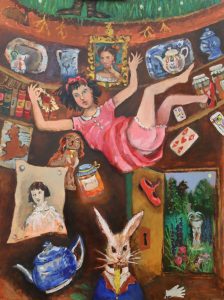
Falling
100 x 76cm£ 2,000.00 Buy -
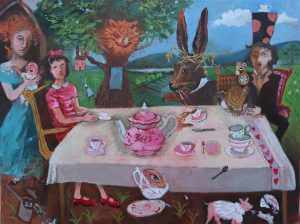
A Mad Tea Party
76 x 100 cm£ 2,000.00 Buy -
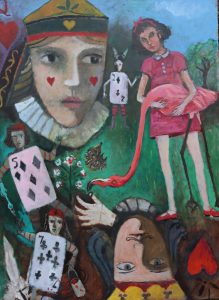
The Croquet Match
76 x 100 cm£ 2,000.00 Buy -
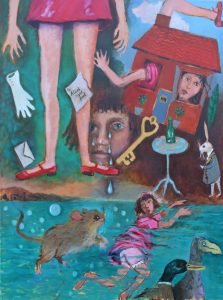
The Sea of Tears
100 x 76cm£ 2,000.00 Buy -
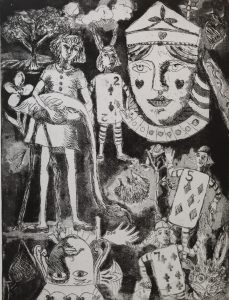
The Croquet Match Etching
57 x 37cm£ 250.00 Buy -
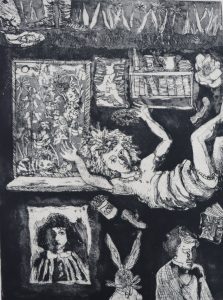
Falling Etching
57 x 37cm£ 250.00 Buy -
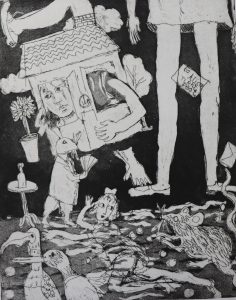
The Sea of Tears Etching
47 x 38 cm£ 250.00 Buy -
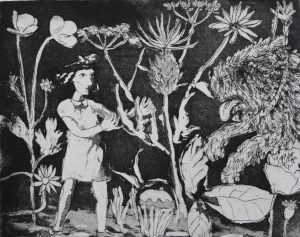
Alice and the Giant Puppy Etching
28 x 38 cm£ 150.00 Buy -
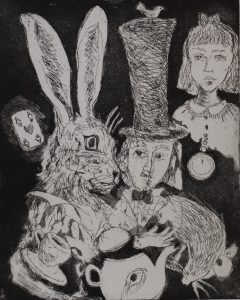
Alice Medley
28 x 38 cm£ 150.00 Buy -
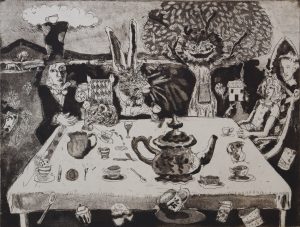
A Mad Tea Party Etching
38 x 57 cm£ 250.00 Buy